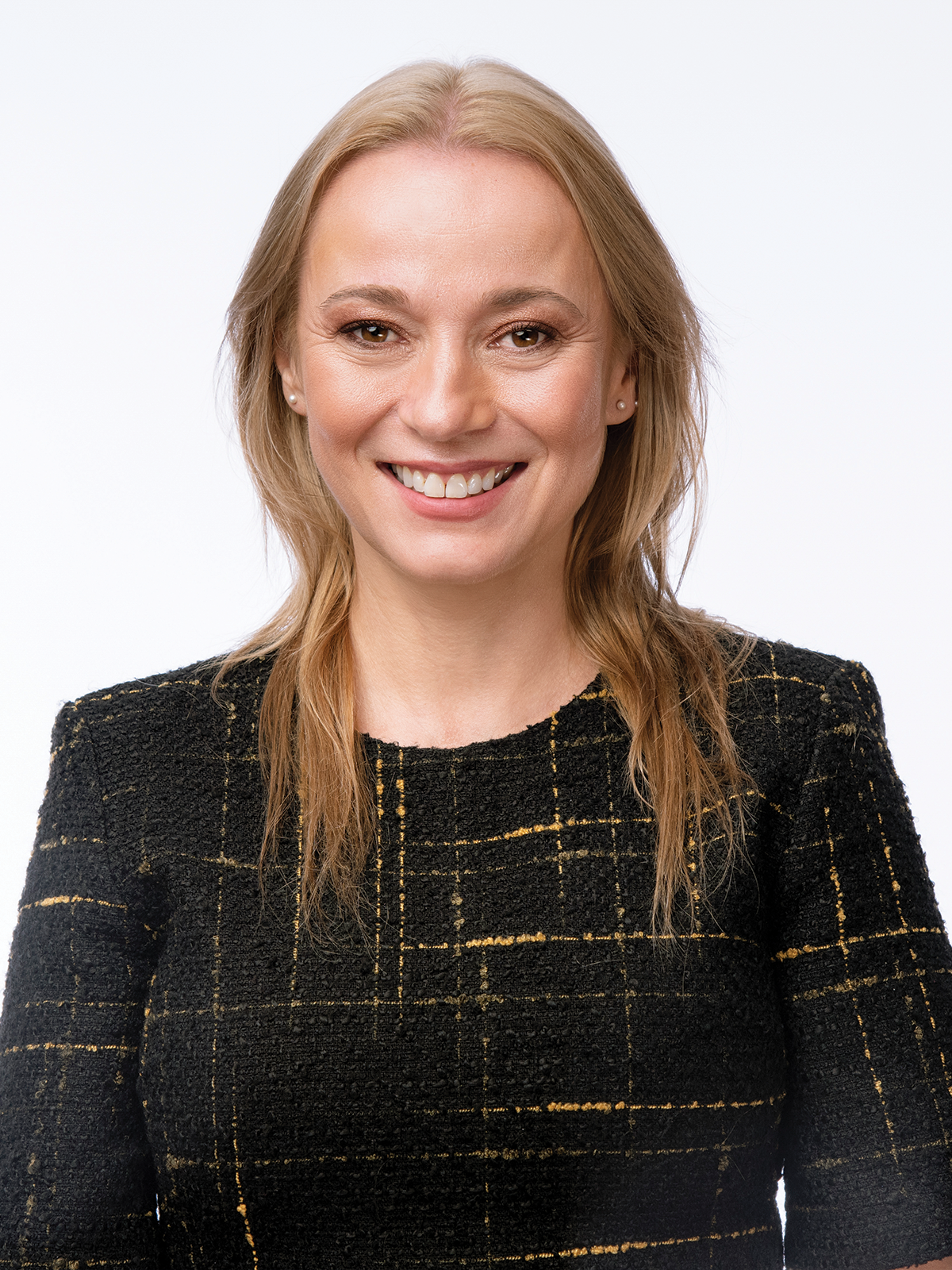

Vanessa Garrido
Tell us about your role and your team.
I joined Deutsche bank more than two decades ago, I relocated to Dubai in 2012 as a senior investment manager to support the MEA team covering Gulf clients.
At Deutsche International Private Bank, an investment manager is a member of the coverage organisation. My team are my partners in the booking centres, the product specialists and the CIO office. The objective is to leverage the full strength of the bank by connecting the powerful wealth management offering with the investment and corporate banking platforms to source bespoke potential solutions for our ultra-high-net-worth clients in the region.
How many fund houses do you work with and how many funds are on your product shelf?
Deutsche Bank has a well-established open architecture platform. We have an experienced team of dedicated analysts and product specialists globally. Our clients have access to active managers, passive managers and alternatives managers.
At Deutsche Bank, we can leverage our extensive industry network to monitor and gain access to elite managers across all favoured strategies.
In addition to our asset management franchise DWS, which offers mutual funds, ETFs and alternatives/specialist mandates our clients have access to our Investment Banking proprietary managed account platform dbSelect and we partner with 100+ third-party providers. There are currently 300+ best-in-class on-the-shelf products across our multiple booking centres.
What new strategies have been added this year?
Our portfolio management strategy contemplates investing in key themes. These are designed to have long-term relevance and to identify investment opportunities beyond 2023.
We have been developing our key investment themes for over five years. They can be visualised as sitting within what we call the TEDs triangle – bounded by the three dimensions of technology, demographics and sustaining the world we live in. New products target artificial intelligence, cybersecurity, healthcare and medtech, hydrogen, infrastructure, millennials and Generation Z, smart mobility and the blue economy.
ESG investing has become increasingly central to the investment universe.
Alternatives, including liquid alternatives, are going to be key to implementing our secular-trend themes. The team has doubled in size and we expect the product offering to grow substantially. The aim is to have a core multi-asset alternative solution complemented with two to four thematic solutions a year.
On a more tactical note, inflation has been the main topic of discussion. Inflation-linked products and hedges have been popular. As an example, products and strategies include ETFs inflation linkers and inflation-index cashflows generated from real assets like real estate and infrastructure.
In addition, 2022 was an exceptional year for historical correlation reference levels. Uncorrelated strategies came back to the forefront via alternative investments including liquid alternatives, hedge funds and venture capital. The best companies are scaling to unprecedented size and maturing in the private markets. Investors such as hedge funds, sovereign wealth funds, wealth clients and corporates have either entered or are trying to enter the venture ecosystem.
Are there specific asset classes where you would like to see new products emerge?
Higher rates will in our opinion encourage a reappraisal of the relative appeal of different asset classes. We have seen ‘income’ return to ‘fixed income’ after a decade of extremely low yields. As a result, asset allocators and clients are looking for fixed income solutions despite the possibility of default rates rising from very low levels.
The opportunity set for fixed income assets should become more comprehensive. There is demand for traditional strategies including government bonds and floating rate notes but also more opportunistic investments in investment grade and fixed maturity propositions. The offering should target public and private markets including private credit.
Moreover, investors are interested in a wider scope of investment opportunities beyond traditional solutions. Mitigating volatility in the current environment is becoming quite challenging. To fulfil this purpose, allocating to uncorrelated, convexity, volatility and non-cyclical strategies such as infrastructure or hedge funds could be beneficial for portfolios. On one hand, infrastructure offers portfolio diversification and relatively stable and inflation-indexed cash flows generated from real assets. On the other hand, hedge funds aim to take advantage of volatile markets by capturing absolute returns across asset classes.
Local equity and fixed income are very popular in the GCC. Do you use global asset managers in these sectors or do you prefer to go with local asset managers?
The open architecture platform gives us access to managers across the globe. We partner with global asset managers that have local teams of managers and hence facilitate access to regional on-the-ground expertise. We are actively monitoring the space.
Which sectors have been most popular with your clients this year?
In the context of heightened volatility and active rotation between growth and value we have seen activity across technology, financials, healthcare, commodities and thematics in general. Flows in passive investments have not been insignificant. In terms of asset classes, fixed income and alternatives lead the way. Geographically, the focus has been on developed markets more than in emerging markets.
Sum up your investment philosophy in a few words.
We offer a modular solution investment approach that includes core plus satellite investments:
- Discretionary strategic asset allocation solutions for the core of our client’s portfolios.
- Specialised complementary solutions, including exposure to alternative asset classes and tactical CIO opportunities.
- Thematic investments that focus on our long-term secular themes and target structural changes in the economic environment (technology, demographics and sustainability).
- High conviction: stand-alone opportunities in public and private markets.
- Strategic liquidity to optimise liquidity needs, provide opportunistic cash and take advantage of our state-of-the-art FX platform.
From your perspective what are the most important traits in a manager?
We implement a stringent due diligence and independent risk management process to ensure best-in-class selection. There is a systematic approach to idea sourcing, due diligence, manager selection, portfolio construction and monitoring.
The due diligence and approval process monitors four quadrants: Manager screening, qualitative analysis, quantitative assessment and operational due diligence (ODD).
- Quantitative parameters look for managers with a disciplined, structured investment and risk management philosophy that have delivered a good track record.
- The qualitative review pays special attention to transparency, team ethics, alignment of incentives, acceptable terms and reputation, and it requires an on-site meeting before the final approval.
- Our operational due diligence highlights are trading discipline and controls, technology systems and backup procedures, suitability of internal compliance procedures, regulatory filings, organizational governance and personnel, custody, counterparties and key service providers, disaster recovery provisions and office security concerns.
- For alternatives and hedge funds, we have an independent second layer of ODD provided by a leading industry consultancy firm.
What is your biggest concern in the current market situation?
Indicators point to a very gloomy sentiment in the current uncertain times. The shifting geopolitical and macro environment poses challenges and risks: inflationary expectations, recession fears and a global synchronised rising rate environment that has historically challenged equity and bond returns. As a result, we have seen elevated volatility across all asset classes.
During times characterised by uncertainty, in our opinion diversification and risk management remains critical. Balancing returns versus risk is a key element in developing robust portfolios. We implement a cost-efficient systematic hedging process – what we call ‘risk-return engineering’ can be designed to allow an increase in the allocation to higher-yielding assets whilst reducing downside risk.
Hedging may offer additional opportunities, especially for investors with long-term horizons. Empirical evidence shows that it pays to be invested even in times of uncertainty. Missing the 10 best days of the S&P 500 between 1996 and 2022 would have cut the performance of the portfolio by 54%.
Favourite quote
‘Never let a good crisis go to waste.’ – Winston Churchill. It is inspirational in the current environment.
What is a hobby you have picked up recently or would you like to get into?
Arts and crafts with my seven-year-old daughter. It is very relaxing, and an excellent way to get her into the family passion and tradition of collecting art.